

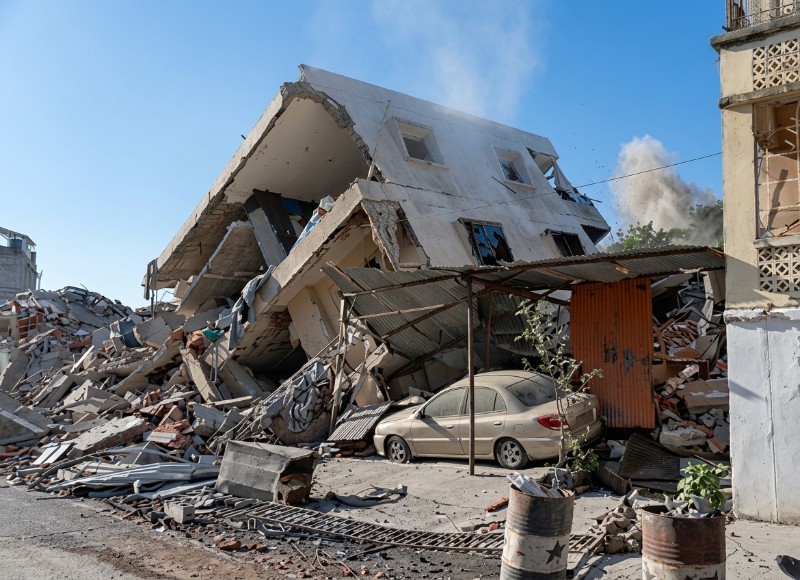
 Widespread destruction reported in Doueir Municipality in the Nabatieh district of southern Lebanon following Israeli airstrikes. Photo: Screen-grab from X
US-Iran ceasefire on shaky grounds! Lebanon front threatens to derail fragile truce
After weeks of sustained military exchanges involving the United States, Israel, and Iran, a temporary ceasefire has offered a brief pause in a rapidly escalating regional conflict.
Yet beneath the surface of this two-week truce lies a critical fault line that could determine its survival.
While the agreement aims to halt hostilities across the Middle East, ongoing military operations in Lebanon threaten to undermine the entire framework.
The ceasefire, announced by Pakistani Prime Minister Shehbaz Sharif, has been presented as a comprehensive halt to violence, intended to create space for diplomacy between Iran and the United States.However, diverging interpretations of its scope, particularly regarding Lebanon, have already exposed the arrangement's fragility.
Conflicting interpretations of the truce
Sharif described the agreement as an “immediate ceasefire everywhere”, including Lebanon.
However, Israeli Prime Minister Benjamin Netanyahu publicly clarified that Israeli military operations in Lebanon would continue despite the broader truce.
This position directly contradicts key elements of Iran’s proposal, which calls for a halt to hostilities not only against its territory but also against its regional allies.
The disagreement highlights a fundamental divergence in expectations between the parties involved, raising doubts about whether the ceasefire can hold even for its intended duration.
Lebanon: The critical flashpoint
At the centre of the uncertainty is Lebanon, where Israeli forces have been actively engaged in military operations.
Israel launched a ground offensive earlier this year, aiming to establish a buffer zone up to the Litani River.
The objective, according to Israeli officials, is to deter attacks from Hezbollah, a powerful Iran-backed group.
The conflict in Lebanon escalated following retaliatory strikes by Hezbollah, which cited Israeli actions against the Iranian leadership as a trigger.
Since then, the situation has intensified, with significant casualties and large-scale displacement reported by Lebanese authorities.
The continuation of Israeli operations in this theatre risks provoking further retaliation from Hezbollah, which could in turn draw Iran back into direct confrontation.
Iran’s conditions and regional alliances
Tehran has made it clear that any sustainable ceasefire must extend beyond its own borders to include all allied groups across the region.
In its proposal, Iran has emphasised the need to halt military actions against what it calls the “Axis of Resistance”, a network of aligned forces operating across multiple Middle Eastern countries.
This coalition includes Hezbollah, which has long played a central role in Iran’s regional strategy.
For Tehran, any continued targeting of these groups undermines the essence of the ceasefire and weakens the prospects for meaningful negotiations.
The US administration, led by President Donald Trump, has described Iran’s proposal as workable in principle.
However, the divergence between Israeli and Iranian positions on Lebanon remains unresolved.
Signs of instability already emerging
Even as the ceasefire came into effect, reports of ongoing hostilities underscored its fragile nature.
Missile alerts were recorded across several Gulf countries, while infrastructure in key energy hubs faced renewed threats.
Earlier strikes on Iranian facilities further illustrated the volatility of the situation.
Analysts have pointed to a deep trust deficit between Washington and Tehran as a major obstacle.
The absence of confidence, coupled with the complexity of regional alliances, has made the ceasefire inherently unstable from the outset.
This lack of certainty has also prompted precautionary measures.
Diplomatic advisories, including those issued by the Embassy of India in Tehran, have urged nationals to leave Iran despite the temporary cessation of hostilities.
Diplomatic efforts amid uncertainty
Delegations from Iran and the United States are expected to meet in Islamabad for further discussions aimed at transforming the temporary truce into a longer-term agreement.
These talks are seen as crucial for addressing the underlying issues that have fuelled the conflict.
However, the success of these negotiations depends heavily on developments on the ground.
Continued military activity in Lebanon risks undermining diplomatic momentum and could derail efforts before substantive progress is made.
A ceasefire under immediate test
The two-week ceasefire now faces its most significant challenge in Lebanon.
As Israeli operations continue and Iran insists on broader guarantees, the possibility of renewed escalation remains high.With multiple actors involved and conflicting objectives at play, the durability of the truce remains uncertain.
Top Headlines
-
News
US-Iran ceasefire on shaky grounds! Lebanon front threatens to derail fragile truce
April 08, 2026
-
News
Hope to see lasting peace in West Asia: India welcomes US-Iran ceasefire
April 08, 2026
-
News
IRGC Intelligence Chief Majid Khademi killed in Israeli-US strike
April 06, 2026
-
News
Inside the daring US mission to rescue downed airman in Iran amid race against time
April 05, 2026
-
News
Gates of hell will open: Iran mocks Trumps 48-hour ultimatum, warns of devastating retaliation
April 05, 2026
-
News
Posted a war imageNow arrested: UAE detains flight attendant in Dubai crackdown
April 05, 2026
-
News
'We will strike inside homes, RSS camps in future: Pak Defence Minister issues direct warning to India
April 03, 2026
-
News
'Did I commit a crime?': Raghav Chadha breaks silence after AAP drops him as Rajya Sabha deputy leader
April 03, 2026
-
News
Mamata blames AIMIM, ISF, Congress, BJP for Malda hostage incident; takes credit for masterminds arrest
April 03, 2026
-
News
Malda hostage horror: Mastermind Mofakkarul Islam nabbed at Bagdogra Airport!
April 03, 2026