
Relics story
The Piprahwa relics, associated with Lord Buddha, has evinced a lot of public interest in India and the Buddhist-majority countries recently, especially after a purported auction was blocked at the last moment. Ranjita Biswas delves into the controversy with help of the publication Crystal & Ash: The Buddha of Piprahwa
The Piprahwa relics associated with Lord Buddha suddenly caught public attention last year as the collection of a private owner was about to go under the hammer and at the last moment it was blocked at the intervention of the Indian government.
On May 5, 2025, GOI issued a legal notice to Sotheby’s Hong Kong, and a descendant of the Peppe family (who was putting up the collection for sale) emphasising its importance as protected antiquities emphasising that Buddha’s relics could not be put up as objects for sale.
Later, GOI facilitated a public-private arrangement to bring back the relics home with the understanding that the collection would be loaned to the National Museum for five years. The relics were on display in Ladakh recently at the initiative of the museum to the great joy of the people in the Buddhist-majority region.
Till recently, one can well say, attention to the collection and its importance was limited to Buddhist scholars, researchers and sections of worshippers.
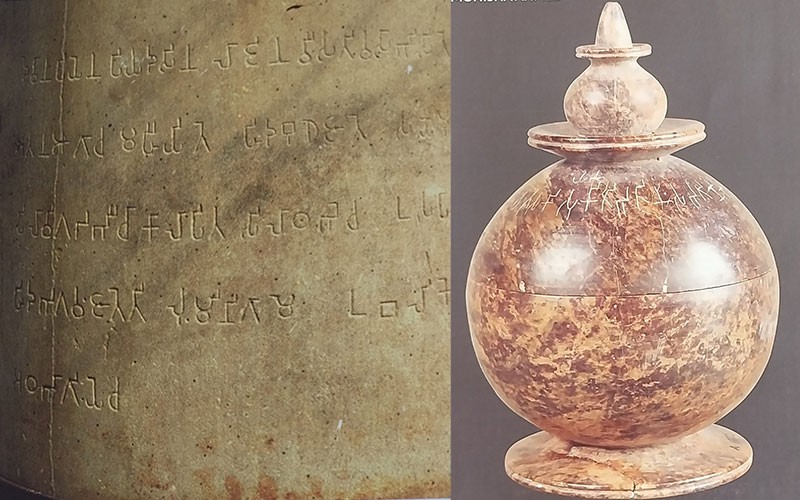
What’s so special about the Piprahwa relics? It is a part of ‘relic deposits’ of Buddhist funerary traditions discovered in Piprahwa, now in UP on the Nepal border, in 1898. After a digging in his Birdpore Estate, Britisher William Claxton Peppe found a large stupa in the backyard with a huge sandstone coffer. A Brahmi inscription on a casket proclaims that it is associated with Buddha and the Sakya clan to which he belonged. Subsequent excavations initiated by the Archaeological Survey of India in the 1970s under director K. M. Srivastava showed that the stupa was a part of an extensive monastic complex.
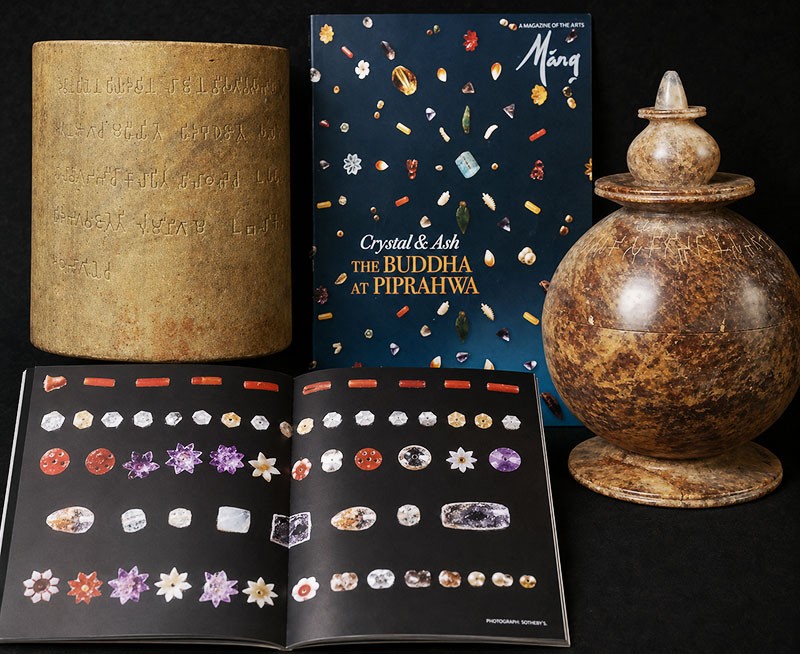
To understand better the importance of theses relics, a good introduction is Marg Publication’s Crystal & Ash: The Buddha at Piprahwa, an extremely erudite volume (December,2025). Keeping to the tradition of the publication house, it contains essays by experts who have examined different aspects of the relics.
"Commemoration of the dead was one of the visible aspects of worship in Buddhism," writes guest editor Naman P. Ahuja in the introductory chapter to the volume.
Found in a massive stone coffer at the site were disintegrated clay and wood vessels containing ashes, jewels and gold ornaments as well as bones and petrified rice which have tremendous archaeological value for dating.
‘It needs to be understood that items excavated from stupas in the 19th century were regarded as “objects” as much by the Europeans as well as most Indians who were far removed from a living Buddhist culture. However, for practising Buddhists, the importance of the relics was immediately apparent,’ Ahuja writes.
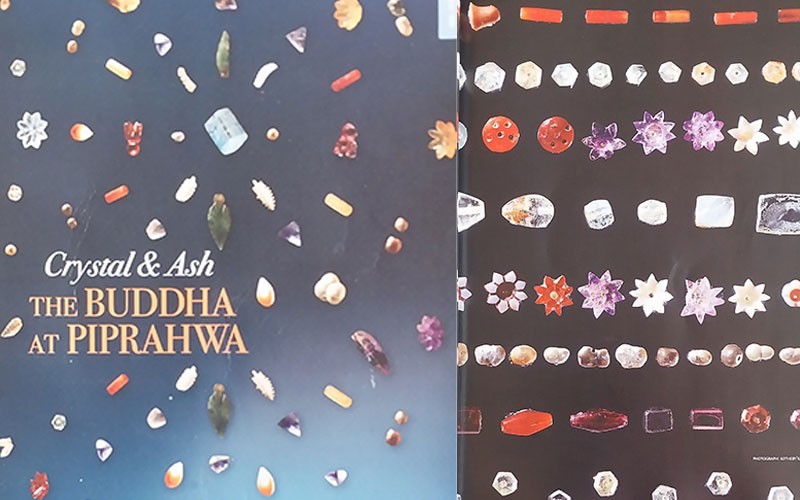
Jewels and gems were aplenty in the coffer. In an article William Peppe wrote later where he described … “ornaments in gold; gold beads…pearls …pierced and drilled beads of various sizes and shapes cut in white or red cornelian, amethyst, topaz, garnet, coral and crystal,” which John S. Strong, professor of religious studies, quotes in the essay Beads and Bones: The Case for the Piprahwa Relics (an excerpt). He points out that the Indian Treasure Trove Act at that time decreed that the gems belonged to the British state (and so were sent to the Indian Museum in Calcutta) but it also allowed the discoverer to retain some portion of the finds if they were deemed to be “duplicates” - identical to others in the trove. That’s how after an inventory made by both Peppe and district judge Vincent Smith, part of the gems remained with Peppe on his return to England in 1903.
In his essay Report on the Beads and Related Objects from the Piprahwa Stupa Jack Ogden, a British expert on the history of jewellery, writes, “The high quality is particularly noticeable if the group is compared with most other stupa finds from Afghanistan, Bangladesh , Pakistan and India… it says much for the religious or ruling elite who would have owned or commissioned such ornaments -for them quality was as important as quantity more.” He recommends a ‘fuller study’ to garner more in-depth information on these rarities.
An interesting insight into the place of relics in Buddhism is offered by Bill M. Mak, scholar in Buddhist studies, in his essay The Role of Relics in East Asian Buddhism. “Unlike in most orthodox Indian religions where human remains are considered impure and, in most cases, discarded, relics of the Buddha’s body are preserved and are universally venerated by Buddhists of all traditions as prescribed in Buddhist scripture.”
Johannes Beltz, curator of South and Southeast Asian Arts, facilitated an exhibition of the Piprahawa relics at the Museum Reitberg, Zurich, as part of a programme called ‘Next Stop Nirvana’ in 2018-2019. In the article Next Stop Nirvana and the Piprahwa Relics he reiterates, ‘Objects like the Piprahwa relics inherit and carry multiple meanings- sacred and otherwise- each shaped by specific contexts, audiences, times and spaces.’
Suffice it to say, all these scholarly works establish the significance of the Piprahwa relics in the context of India’s socio-religious history and in the realm of Buddhism as well. A reason why the GOI stepped in to prevent a ‘colonial exploitation.’
(Pix courtesy: Crystal & Ash: The Buddha of Piprahwa. Marg magazine)
Top Headlines
-
Art and Culture
Where governments stop, institutions begin: Culture Minister Shekhawat salutes Prabha Khaitan Foundation
October 03, 2026
-
Art and Culture
National Award-winning Ramnami puts spotlight on community behind Chaltabagans Nishan theme
September 24, 2026
-
Art and Culture
When the Body Becomes a Temple: The Ramnami Samaj's Century-Old Rebellion Now Inspires Kolkata's Durga Puja
September 03, 2026
-
Art and Culture
From Ramnami tattoos to a global app: Chaltabagan's 'Nishan' takes Durga Puja beyond Kolkata
September 01, 2026
-
Art and Culture
Prabha Khaitan Foundation, French Embassy explore deeper Indo-French cultural collaboration
July 17, 2026
-
Art and Culture
Relics story
June 24, 2026
-
Art and Culture
World Music Day 2026 Concert Writes a New Chapter in Kolkata's Cultural Soul
June 23, 2026
-
Art and Culture
New Sheriff Goutam Ghose to unlock Kolkata's buried colonial past records untouched since the East India Company
April 08, 2026
-
Art and Culture
Beloved Timekeepers: From Kolkatas New Market Clock to Icons Around the World
March 26, 2026
-
Art and Culture
Sacred Waters, Shared Faith: Panchu Dola Melana Lights Up Odishas Chilika Lake
March 16, 2026