

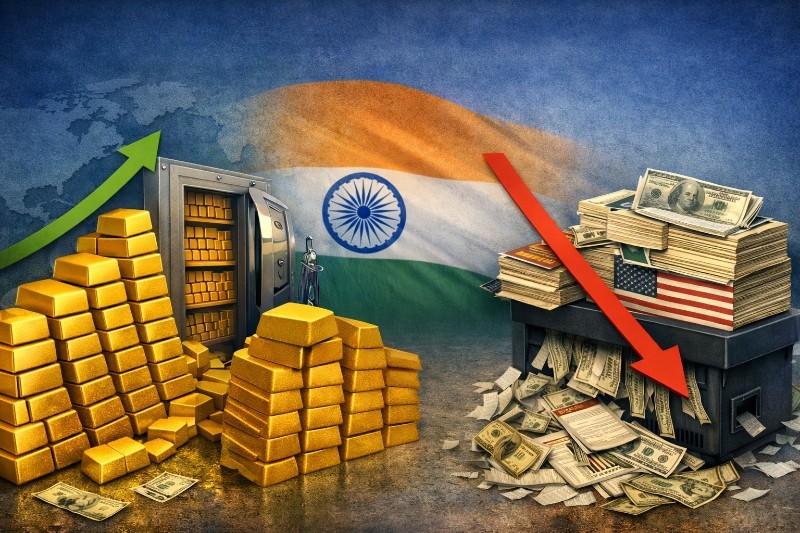
 India is recalibrating its foreign exchange reserve strategy away from US dollar dependence. Photo: AI composition by ChatGPT
Is India moving away from the Dollar? Strategic shift in foreign reserves signals a new era
In recent months, India’s foreign exchange reserve management has attracted global attention.
Data reveals that the Reserve Bank of India (RBI) has reduced holdings of US Treasury bonds to the lowest level in five years, trimming exposure to dollar-denominated assets while strengthening other components of its reserves.
This strategic pivot has sparked questions about whether India is charting a gradual shift away from heavy reliance on the US dollar.
US Treasury bonds are regarded as the safest benchmark asset as they are backed by the full faith and credit of the US government, making them virtually risk-free. They therefore serve as the global "risk-free rate", against which other investments—from corporate bonds and mortgages to equity valuations—are priced.
India has traditionally held US Treasury bonds as part of its foreign exchange reserves due to their safety, deep liquidity, and reliability, helping the RBI manage reserves, maintain currency stability, and support external trade.
India’s US Treasury holdings have fallen significantly over the past year, with figures showing a decline of around 21 percent over a 12-month period.
This move brought the value of US government bonds in India’s portfolio from approximately $241.4 billion to around $190.7 billion, reaching a five-year low.
Economic analysts note that the share of Treasuries in India’s foreign exchange reserves has also been reduced, decreasing from about 40 percent of total reserves to closer to one-third in recent months.
Diversification and long-term reserve strategy
Alongside trimming US bond holdings, the RBI has been expanding the range of assets held within India’s reserves.
Notably, gold has emerged as a growing pillar of the reserve portfolio.
Central bank data shows that India’s gold holdings have risen steadily in recent years, with the total now representing a significant share of overall reserves.
Gold’s value and strategic importance have enabled it to complement other reserve assets, such as foreign currency holdings denominated in euros, yen and sterling.
Gold’s prominence in India’s reserves is part of a broader trend among central banks worldwide.
Many global monetary authorities have increased their gold allocations to enhance diversification, reduce concentration risk in any single currency and bolster financial stability.
This trend, often discussed in financial circles as de-dollarisation, reflects a measured response to shifting global economic dynamics over the past decade.
India’s foreign exchange reserves as a whole remain robust.
Recent data from the RBI shows that the total reserves reached a record high of over $709 billion, underpinned by foreign currency assets, gold and other reserve components.
Gold valuations and strategic foreign exchange swaps have contributed to this historic level, even as traditional dollar assets play a smaller relative role than before.
Broader global context
India’s recalibration mirrors a wider pattern observed among many major economies.
Central banks in Asia, Europe and beyond have been adjusting reserve compositions, taking cues from global economic developments and geopolitical considerations.
Some nations have diversified into euro-denominated assets, others have deepened holdings in alternative currencies such as the Chinese yuan, while a number have increased gold reserves as a stabilising asset.
This global context underscores that India’s strategy aligns with evolving international reserve management practices.
Financial institutions worldwide evaluate reserve allocations based on a mix of economic signals, market conditions, and risk mitigation needs.
In this environment, rebalancing portfolios can help ensure that reserve assets remain responsive to both domestic and international imperatives.
Reserve diversification as policy framework
India’s shift in reserve composition is rooted in long-term fiscal stewardship and strategic reserve management.
Through a careful reduction in US Treasury holdings and expansion of alternative assets like gold and non-dollar currencies, India’s reserve framework is adapting to the contours of the global monetary landscape.
While the US dollar remains a cornerstone of global finance, the diversification occurring in India and other economies illustrates a proactive approach to reserve management.
According to economists, by broadening the structure of its foreign exchange reserves, India is positioning itself to navigate future market developments with flexibility and strength.
Top Headlines
-
News
After days of silence, China confirms Xi Jinpings India visit for BRICS Summit
September 10, 2026
-
News
ISKCON Juhu in trouble: FDA suspends licences of 3 restaurants over serious hygiene violations
September 09, 2026
-
News
Sona College of Technology's 25th graduation day: 1,325 students receive BE, BTech, ME, MCA, MBA and PhD degrees
September 09, 2026
-
News
Air India sacks Phuket-Delhi pilot who tested positive for psychoactive substance
September 04, 2026
-
News
Gloria Steinem, who gave second-wave feminism its face and its argument, dies at 92
September 04, 2026
-
News
Rs 20 bribe case ends after 30 years as Supreme Court acquits Gujarat employees
August 19, 2026
-
News
RG Kar rape-murder case takes fresh turn as ex-TMC MLA Nirmal Ghosh arrested over cremation probe
August 13, 2026
-
News
Vijay-Sangeetha divorce case closed as wife withdraws petition
August 07, 2026
-
News
Journalist harassment during CJP protest: Kolkata Police recreate crime scene with barefoot accused
July 27, 2026
-
News
Reliance Industries posts record quarterly revenue of 3.4 lakh crore, Jio IPO on the horizon
July 17, 2026